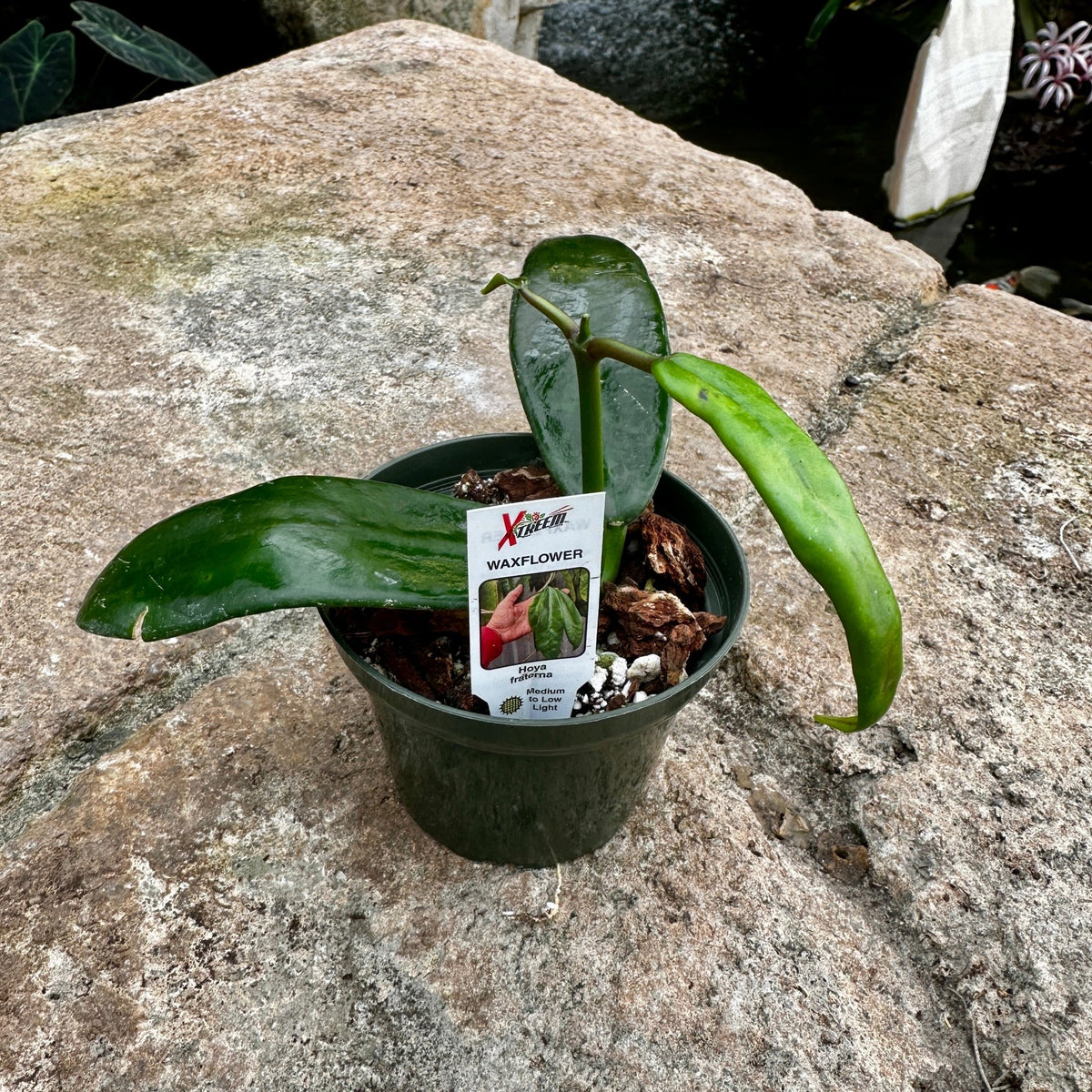
Hoya fraterna
Hoya fraterna
Couldn't load pickup availability
Share
Most Hoyas are sold on their flowers. This one earns its place on its leaves.
Hoya fraterna—sometimes sold as Hoya meliflua subsp. fraterna, and also known as Hoya treubiana—is a large-leaved climbing wax plant from Indonesia, described by Blume in 1849 from material collected in western Java. Its defining feature is foliage: broad, thick, jade-green leaves that are leathery and rubbery to the touch, often dimpled or puckered, and flecked with silver speckling that catches the light. Leaves can reach 15–25 cm, with some reports of specimens pushing toward 20 cm or more on well-grown plants. It is, by any measure, a big-leaf Hoya.
The bloom is worth the wait. When it flowers, fraterna produces large umbels of velvety pink flowers with a yellow-red center, and the scent is genuinely distinctive—butterscotch, or caramel, depending on who you ask. Growers describe it as an impressive foliage plant first and a flowering plant second, which is a fair summary of how it behaves: it puts energy into vining and leafing before it puts energy into blooming.
How it grows. A robust epiphytic vine, fraterna wants to climb. Indoors, expect vines 2–3 m (6–10 ft) with support—and it can be kept much smaller or allowed to run, depending on how you train and prune it. It is a fast grower once established, capable of adding a meter or more of stem in a good summer, so plan for a trellis, a hoop, or a hanging basket from the start.
Care Instructions:
Bright, indirect light—close enough to a south or east window to feel the brightness, with a sheer curtain or a few feet of distance keeping harsh sun off the broad leaves. Bright indirect light brings out the silver speckling and promotes flowering. A little filtered morning sun is fine; intense midday sun bleaches and burns the leaves.
Water when the top 1-2 in of mix is dry—roughly every 7–14 days in active growth. Soak thoroughly, then let the surface dry, and empty any drainage saucer afterward. The thick, succulent leaves hold reserves, so err toward underwatering. Cut back significantly in cooler, lower-light months to avoid rot. The finger test or lifting the pot is more reliable than a fixed calendar.