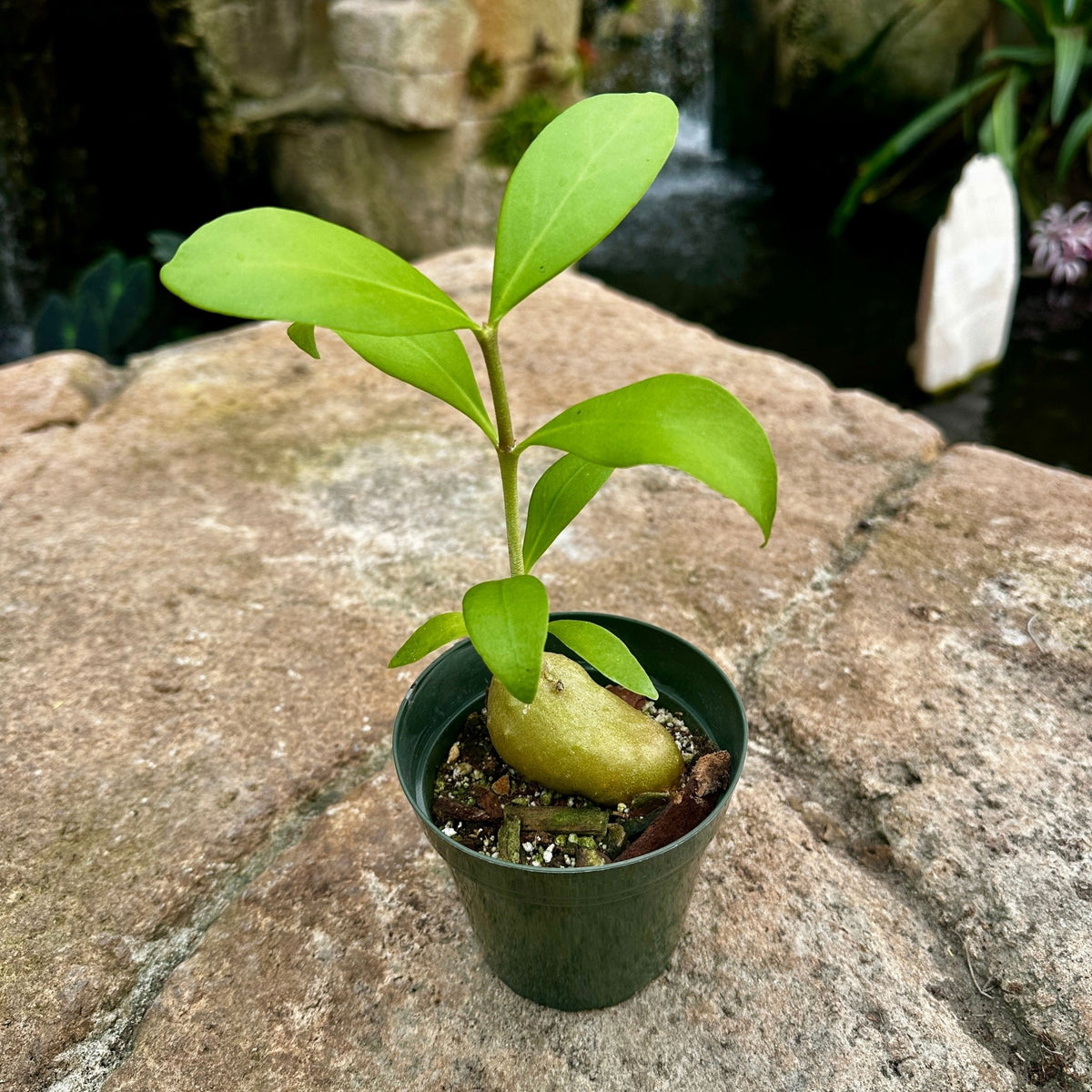
Hydnophytum formicarum
Hydnophytum formicarum
Couldn't load pickup availability
Share
This is not a plant you grow for flowers. It is a plant you grow for the lump.
Hydnophytum formicarum—the Ant Plant, or Baboon's Head—is a myrmecophyte: a plant that has evolved a mutually beneficial relationship with ants. Its defining feature is a swollen, woody caudex covered in corky bark and honeycombed with internal chambers. Those chambers are not decorative. In the wild, they house ant colonies, which defend the plant from herbivores and deposit waste that feeds it. The relationship is genuinely mutual: the ants get shelter, the plant gets nutrients and protection.
What it looks like. The caudex is globose to oblate, spineless, and can reach 10–55 cm in diameter (some sources report up to 60 cm), forming a swollen mass over time. From its apex emerge two to four slender, branching stems that can reach about 60 cm long. The leaves are opposite, elliptical to obovate, 4–15 cm long and 2–7 cm wide, with a leathery texture and prominent midribs—glossy and fleshy to the touch. The flowers are small, white, four-merous, and appear in axillary clusters of 3–10. They are followed by orange to red, fleshy fruits 6–7 mm in diameter containing sticky seeds.
Where it comes from. H. formicarum is native to tropical Southeast Asia, from the Andaman Islands through Indo-China, Malesia, and the Moluccas to Waigeo Island in New Guinea, and also occurs on the Cape York Peninsula in Australia. It grows as an epiphyte in lowland rainforests, mangrove margins, heath forests, and open-canopied areas, from sea level to roughly 1,500 m elevation, perched on tree trunks and branches under filtered canopy shade.
A note on its status. It is widespread across its range and considered of least concern globally, but it is assessed as critically endangered in Singapore and Vietnam due to localized habitat loss. That combination—widespread but locally imperiled—is worth mentioning, because it means cultivated plants matter for the species' long-term presence in collections.
Care Instructions:
Bright, indirect light or filtered morning exposure. Intense midday sun scorches the leaves and damages the caudex. Bright, diffused light keeps growth compact and supports caudex expansion. Indoors, an east- or west-facing window with a sheer curtain is ideal. Outdoors, dappled shade or a shadehouse.
Water thoroughly during active spring and summer growth, then allow the substrate to dry slightly between waterings. In practice, that means soaking every 10–14 days in warm weather, and reducing to once every three to four weeks in cooler months, keeping just a slight ambient dampness. The caudex stores water, so err toward underwatering. Never let the pot sit in standing water.