Bromeliaceae
Tillandsia angulosa
Tillandsia angulosa
Couldn't load pickup availability
Share
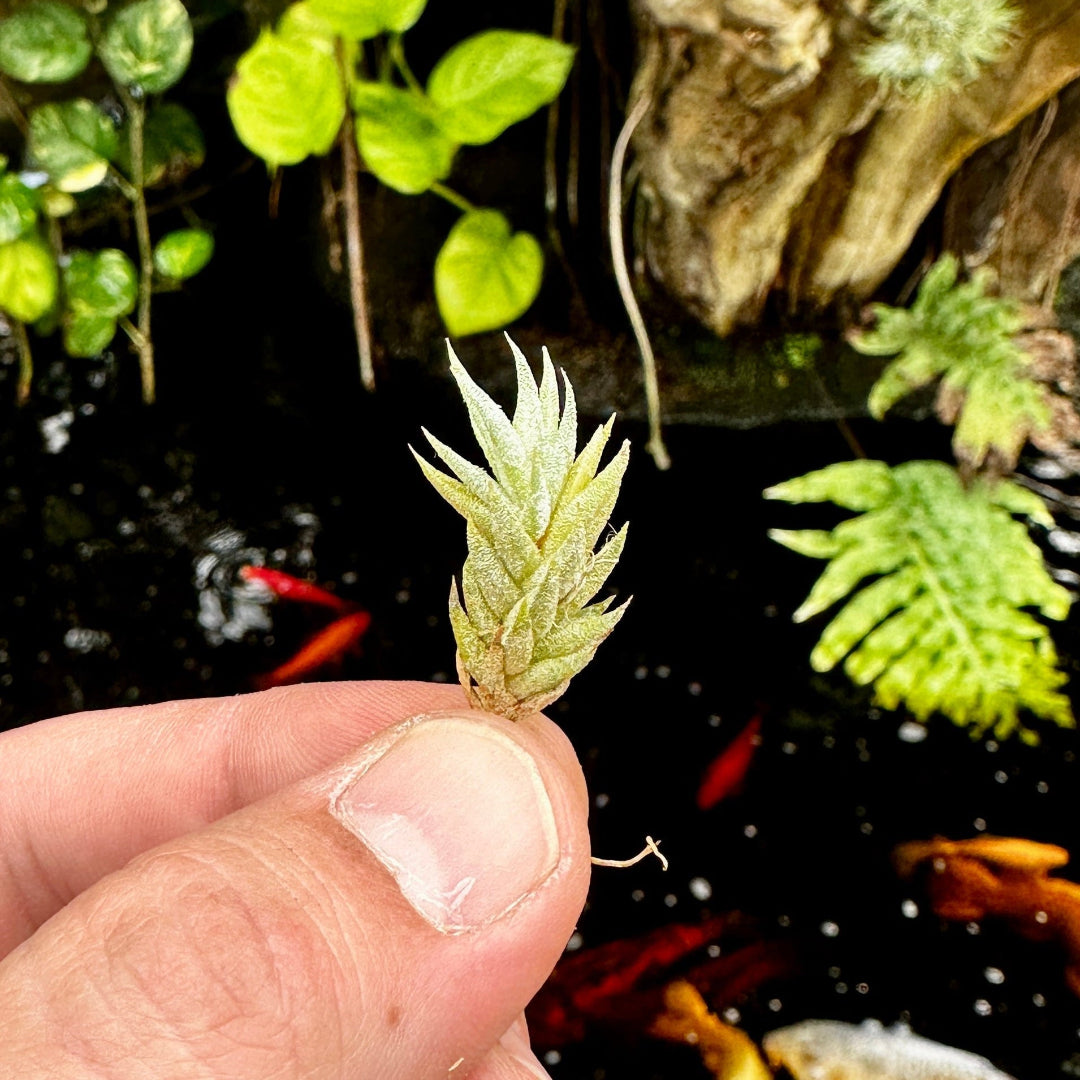
Tillandsia angulosa. This unique species was first described by Carl Christian Mez in 1896 and is native to the semi-arid regions of northwestern Argentina, including La Rioja, Mendoza, Catamarca, and San Juan. It grows as an epiphyte on tree branches and occasionally on rocks or even cacti at elevations between 500 and 900 metres.
The name "angulosa" comes from the Latin word meaning "angular" or "cornered", a reference to its distinctive, sharply angled foliage. This plant forms a pulvinate (cushion-like) mass of many small stems originating from a single point. Its leaves are densely covered in coarse, ash-grey scales (trichomes), giving them a characteristic grey-green colour. The plant is very small: individual rosettes are only about 15 to 20 mm (0.6 to 0.8 inches) wide and 15 mm (0.6 inches) tall. Leaves reach a maximum length of about 1.7 cm (0.7 inches).
A member of the Diaphoranthema subgenus, T. angulosa produces a very short scape (flower stalk) that is hidden by the leaves. The inflorescence is always single-flowered — a single, tubular bloom emerges from the growing point. The petals are a distinctive purple-brown colour and the flower typically lasts for 9 to 10 days. It can be reluctant to bloom, but when it does, it flowers from December to February, making it a unique winter bloomer in the Northern Hemisphere.
This species is easy to cultivate and is a fascinating addition to any collection, especially for enthusiasts of miniature and unusual Tillandsias.
Care Instructions: Provide bright, indirect or filtered light for optimal growth. A spot with partial sun is ideal. Water 2–3 times per week in a hot position, or once a week in a cooler, more humid environment. Water by misting thoroughly or dunking the plant in a bowl of water for 10–20 minutes, then shake off excess water.