Bromeliaceae
Wittrockia 'Leopardinum'
Wittrockia 'Leopardinum'
Couldn't load pickup availability
Share
Most bromeliads sell on their flowers. This one sells on its leaves.
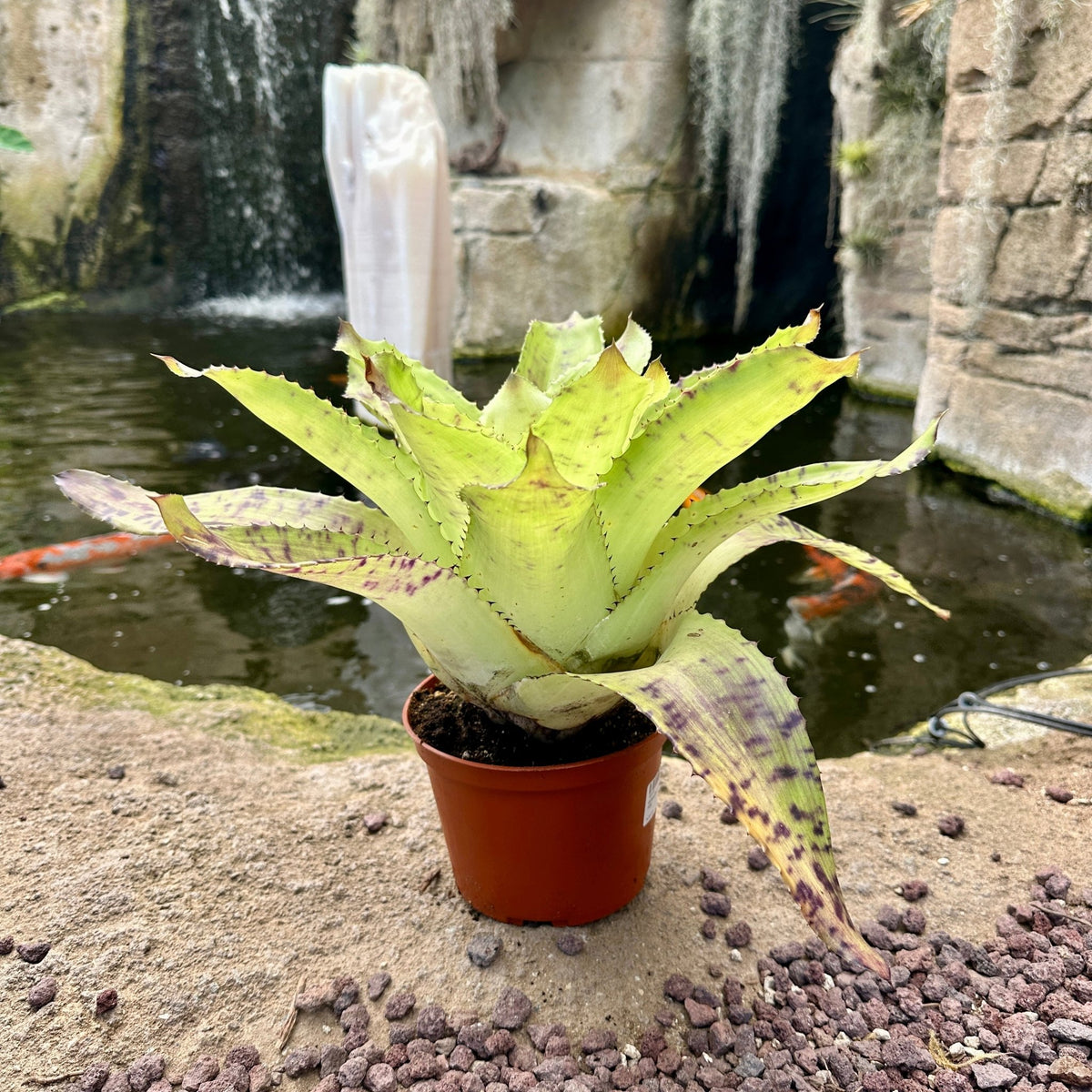
Wittrockia 'Leopardinum' is a rare, slow-growing bromeliad whose foliage is genuinely unlike anything else in the genus. Each leaf is thick, leathery, and strongly sheathed, forming a compact rosette of deep green irregularly spotted with dark purple-brown mottling. The effect is leopard-like—organic, uneven, and impossible to replicate with a paintbrush. Grown in good light, the foliage can take on a purplish-red hue, deepening the contrast further.
'Leopardinum' has bounced around the taxonomic world. It was originally described as Canistrum leopardinum, later treated as a cultivar of Wittrockia gigantea, and is now generally recognized as a stable, distinct form rather than a hybrid. Growers who have raised it from seed report seedlings so uniform they're "as consistent as cloning"—a strong sign it's a true species rather than a chance cross. What matters for you: it's semi-rare in cultivation, it's stable, it's been in specialist collections since at least the late 1970s, and documented as early as 1888.
What it becomes. 'Leopardinum' is slow. Genuinely slow. This is not a plant you buy for rapid growth. What you get instead is longevity and eventual scale: mature rosettes can reach 60 cm (24 inches) across, with individual leaves running 70–80 cm long and 7–8 cm wide. The inflorescence, when it finally arrives, is one of the largest in the genus—a massive, flat, red-maroon structure that emerges near the plant's center rather than on a tall stalk.
Good to Know:
- This plant is slow. Emphasis on slow. If you're looking for fast growth or frequent change, this is the wrong plant. If you're looking for something that rewards patience and lives for years, it's the right one.
- The mottling intensifies with light. Grown in brighter conditions, the spots and the purplish-red cast become more pronounced. In lower light, the plant stays greener and the pattern is subtler.
- Flowering is infrequent. Some growers wait years. The plant blooms once, then produces offsets ("pups") before the original rosette gradually declines. That's the natural cycle.
- The inflorescence emerges near the center. Unlike many bromeliads, this one's flower structure sits low and flat in the rosette rather than rising on a tall peduncle—though some reports put the peduncle over a foot tall depending on the form.
- Taxonomy varies by source. You'll see it listed as Wittrockia, Canistrum, and as a cultivar of W. gigantea. All refer to the same plant.
Caring for Your Plant:
Bright, filtered light. Good light is what brings out the mottling and the purple-red cast. A position with morning sun or dappled light through the day is ideal. Avoid harsh, direct midday sun, which can scorch the leaves. In lower light the plant survives fine but stays greener and loses some of its character.
Keep the central "cup" of the rosette filled with fresh water, refreshing it weekly to prevent stagnation. Water the potting mix when the top inch or two feels dry, allowing it to drain freely. Reduce watering significantly in winter—the plant slows down, and wet soil in cool conditions is the fastest route to rot.